A column heading can make a complicated record look simpler than it is. ‘Issue,’ ‘response’ and ‘date’ appear factual, but they refer to different kinds of information. Before counting records in payment research, write down who supplied each field and what event or classification it represents. Otherwise, a chart may silently convert a reported problem into a verified finding.
Identify the speaker inside the record
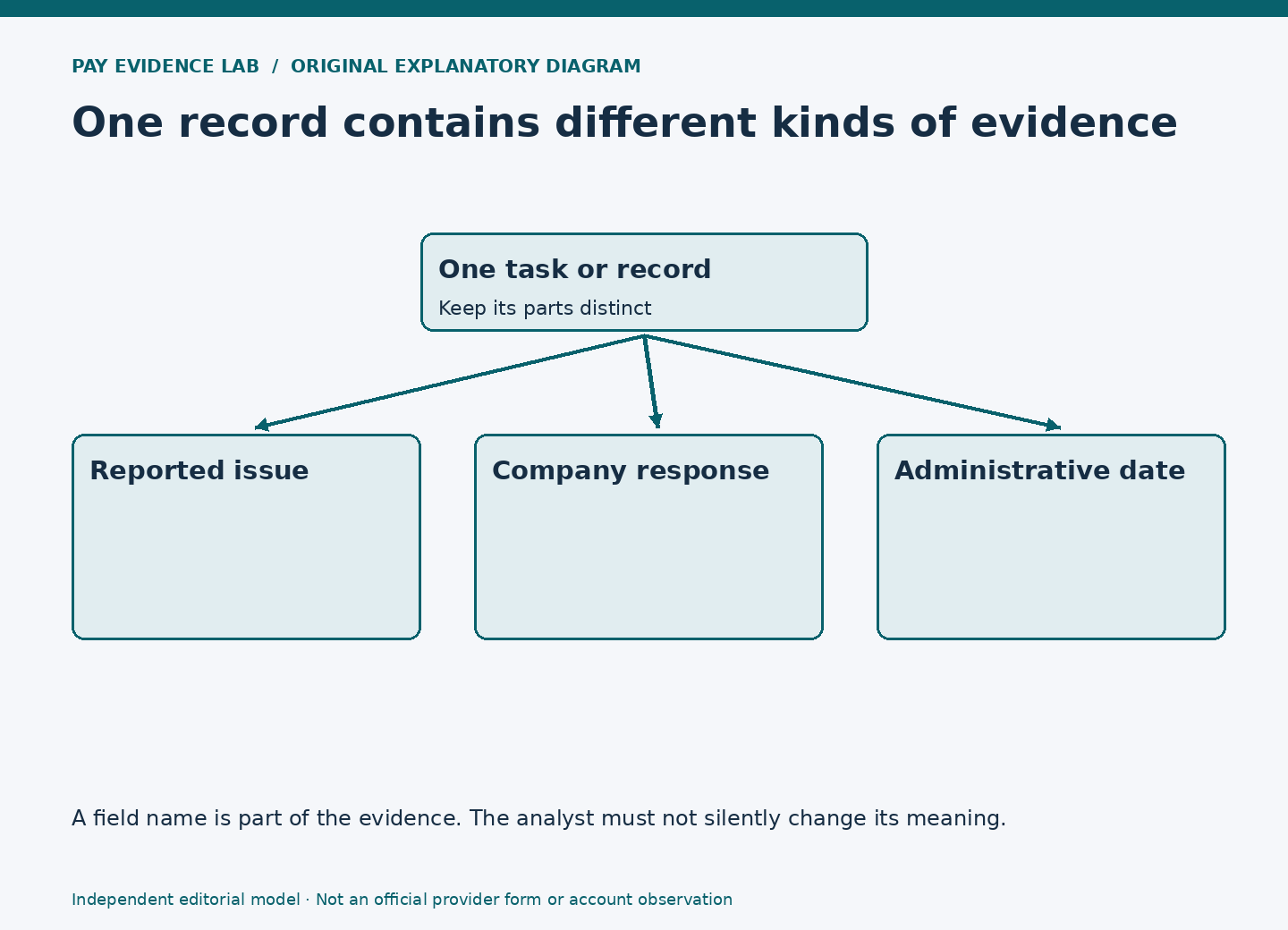
The CFPB field reference describes product and issue selections as consumer-identified categories. It also distinguishes a company’s public response from its response to the consumer. These labels should travel with your analysis. ‘Records classified under an issue’ is different from ‘confirmed incidents caused by the company.’ The first describes the dataset; the second adds a conclusion.
In a fictional research notebook, create three lanes: reported information, response information and administrative information. Place the issue selection in the first, a response category in the second and the date received in the third. The lanes do not decide which party is right. They prevent you from treating all fields as if they have the same evidentiary status.
Keep missing and optional fields visible
An optional public response may be absent. That absence should not automatically become ‘the company did not respond to the consumer.’ The dataset’s field definitions and publication rules determine what a blank can mean. Use a missing-value label that describes the record rather than assigning motive or behavior not established by the source.
The same discipline applies to product detail. A missing subcategory is not necessarily an error, and a broad category may have changed over time. Check the documentation before designing a filter that excludes blanks. A tidy dataset created by dropping inconvenient records can answer a different question from the one you intended.
Build a small translation table
For each field you use, write three entries: source name, plain-language meaning, and prohibited inference. For ‘date received,’ the prohibited inference might be ‘date the underlying problem began.’ For a response category, it might be ‘consumer satisfaction.’ This table becomes a check on chart labels and narrative summaries.
Apply it to an invented sentence: ‘The company solved every timely complaint.’ The sentence joins timeliness and resolution even though they are different concepts. Rewrite it to state exactly which field was counted and leave outcome claims out unless another source establishes them. The revised sentence may be narrower, but it is also reproducible.
Use the record without adjudicating it
Complaint data can point to questions worth investigating and describe what was reported through a channel. An analyst does not need to dismiss it to avoid overclaiming. The useful middle ground is to preserve the source’s status while examining patterns within a clearly defined set.
For Fintwist-related research, verify the relevant company and product scope before interpreting any record. This publication has not matched a real complaint dataset to all Fintwist programs. The field-reading method is a preparation step, not a claim that such a complete matching exercise has already been performed.
Continue the investigation
Sources and scope
- External official source: CFPB Open Tech: complaint field reference — Meaning of date, product, issue, company and response fields. Not a merits decision. Checked 2026-10-04.
- External official source: CFPB: how complaint data is shared — Public fields and separation from identifying information and supporting documents. Checked 2026-10-04.