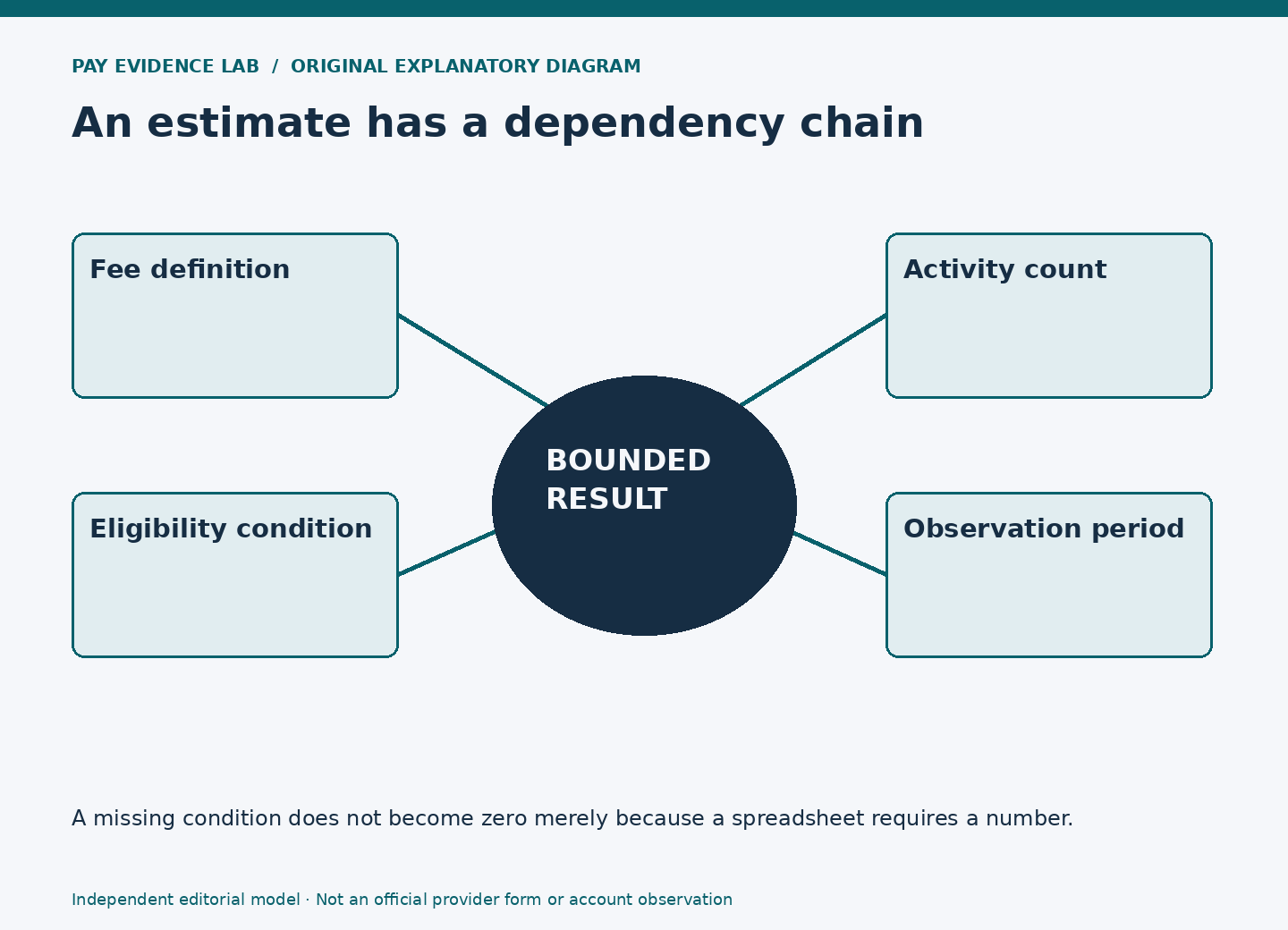
An estimated monthly cost can look authoritative because it ends with a dollar sign and two decimal places. Yet the most important decisions may be hidden upstream: which fee schedule was used, whose activity was modeled, whether an eligibility condition applies, and what period the estimate covers. This article is about evaluating a research model, not choosing a payment account for an individual.
CFPB prepaid materials explain fee disclosures and conditions; they do not supply a universal Fintwist price list. For a real program, the applicable current disclosures and agreement are necessary inputs. If those inputs have not been established, a research model should remain a labeled hypothetical exercise. Do not borrow another employer’s schedule because it makes a worksheet easier to finish.
Make each assumption visible
Start with a ledger rather than a calculator. Give each modeled charge a source, a unit, an activity count, a condition and a period. A per-use charge requires a number of uses. A monthly charge requires a number of months. A waived charge requires evidence that the modeled case satisfies the waiver. ‘Unknown’ belongs in the ledger when the source does not answer the question.
Use a fictional example with a $2 per-event charge and three events in one month. The arithmetic contribution is $6 under those assumptions. That statement is complete only when you keep the word fictional attached. It is not a Fintwist fee, a typical customer’s cost or a forecast. Its purpose is to let a reader inspect how one input affects the result.
Write the model’s exclusions beside its inclusions. If it considers provider charges but not a separately imposed third-party charge, the output should not be called total cost. If it counts one activity but ignores other possible behavior, call it the modeled activity cost. The title of the output is part of the method, not decoration added after calculation.
Change one input before changing the story
Sensitivity analysis asks how the output responds to a changed assumption. In the fictional example, one event costs $2, three cost $6 and five cost $10. The calculation shows that frequency matters. It does not show which frequency is common among cardholders. An observed activity distribution would require evidence beyond this exercise.
Next test the condition. If the fee applies only in a certain situation, compare a case where that condition is met, a case where it is not, and a case where it is unknown. The unknown case should not quietly inherit zero. It should produce an unresolved input or a range whose endpoints and assumptions are clearly described.
Change only one assumption at a time when diagnosing a model. If you simultaneously change the fee, activity frequency and product population, you cannot tell which change drove the result. A small sensitivity table is often more informative than a single best-case figure because it lets the reader see the dependency instead of trusting the conclusion.
Do not invent an average reader
A model based on one invented month describes one invented month. To call the output average, the research would need a defined population, a relevant observed distribution and a method for weighting it. A convenience set of examples is not a population sample. A provider’s general feature page is not a record of how often people use each feature.
Suppose a review gives equal weight to three scenarios: no use, moderate use and frequent use. The resulting mean is an average of those chosen scenarios, not the average cost among actual customers. Equal weighting can be a transparent teaching choice. It becomes misleading when the research drops the qualifier and calls the result typical.
A more useful presentation may keep all three scenarios visible. Explain why each was selected and what it reveals. Readers can learn which assumptions matter without being told that one scenario represents them. The objective is to expose the model’s structure, not persuade every reader to accept a single output as their own likely experience.
Check arithmetic and interpretation separately
An independent reviewer should be able to reproduce the arithmetic from the published fictional inputs. They should also be able to challenge the scope without changing a formula. These are different checks. Passing the first does not settle whether the right fee schedule, population or activity pattern was chosen.
Inspect rounding at the final step, avoid silently combining different currencies or time periods, and preserve units in every heading. If a table changes from monthly to annual values, state the scaling assumption. Multiplying a modeled month by twelve does not demonstrate that behavior or terms remain the same for a year.
Finish with a two-sentence finding: one sentence describes the model under stated assumptions, and the other identifies what prevents a real-world conclusion. For example: ‘In the fictional scenario, activity frequency drives the modeled charge. Actual Fintwist costs cannot be inferred without the applicable program terms and a relevant activity pattern.’ This offers an analytical result without turning a teaching model into financial advice.
Continue the investigation
Sources and scope
- External official source: CFPB: understand a prepaid card disclosure — Fee categories, conditions and the purpose of a sample disclosure. Sample amounts are not Fintwist fees. Checked 2026-10-04.
- External official source: CFPB: payroll-card fees and disclosures — Program fee disclosures and agreements; no universal Fintwist fee schedule. Checked 2026-10-04.