A research brief can become less accurate during its final edit. A careful paragraph says that one public page contains a conditional feature statement. The headline becomes ‘Fintwist feature available to everyone.’ A table counts selected complaint records. The caption becomes ‘failure rate.’ Neither error requires a wrong number; both arise when the wording claims more than the evidence carries.
Pay Evidence Lab uses Fintwist and Corpay Prepaid as a case for reading payment evidence. It does not publish a provider ranking or assert firsthand account testing. The purpose of a bounded finding is to let a reader use the work without inheriting an unsupported conclusion. A clear limit is part of the result, not an apology for having done the research.
Build the brief around four components
The observation states what was actually inspected or counted. The method explains how the material was selected and reviewed. The inference states what follows from that observation under the method. The limitation identifies a specific reason not to generalize further. When all four are present, the reader can disagree productively with the method instead of guessing what the writer did.
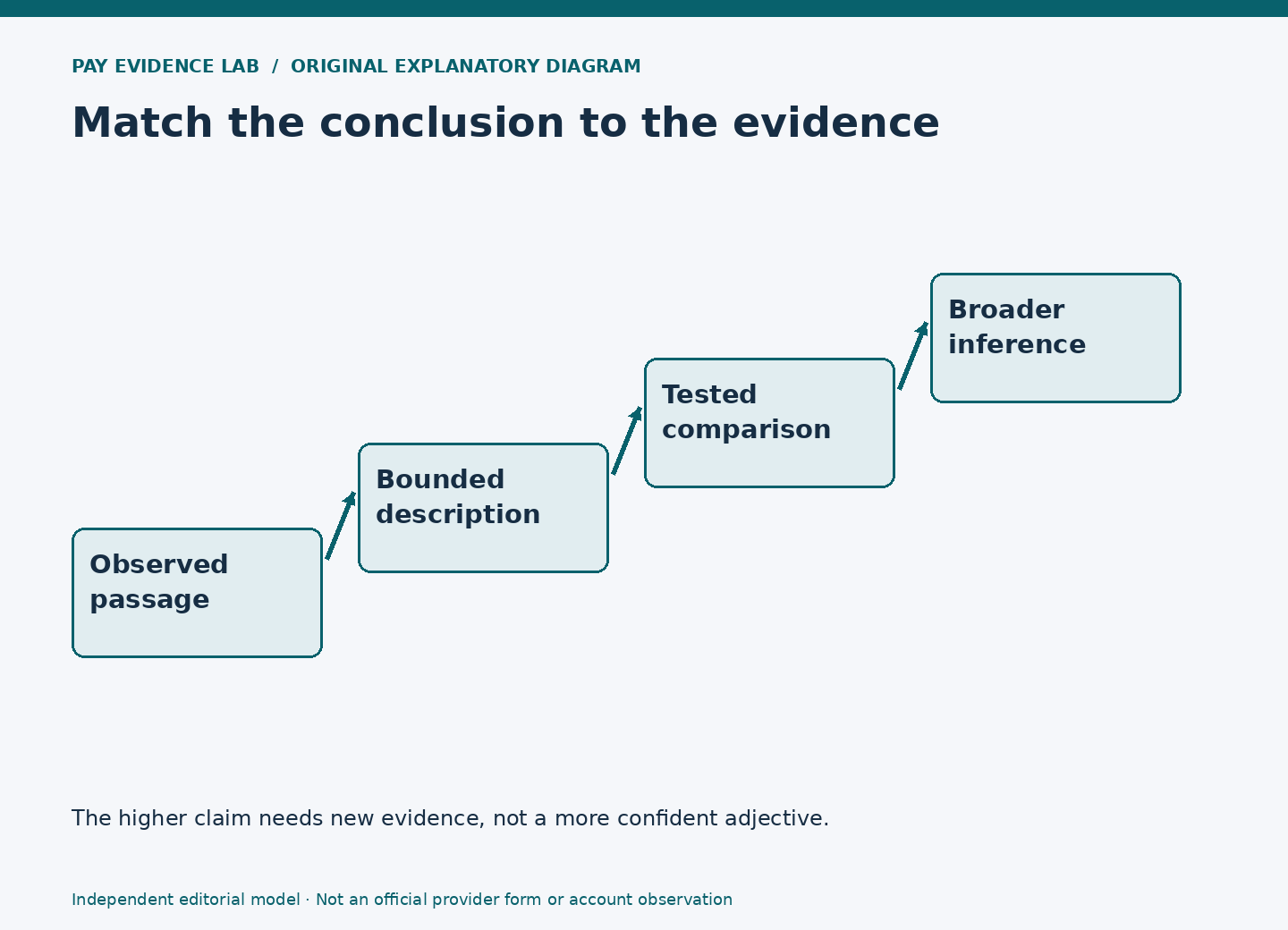
For an original fictional example, imagine a review of three public passages about one payment feature. The observation is that two passages state a condition explicitly and one omits it. The method defines the three sources and the review date. The inference is that the wording differs within that selected set. The limitation is that the exercise does not establish what any individual account can do.
The final sentence should not erase the limitation with a broad recommendation. ‘Therefore use this provider’ or ‘therefore avoid this provider’ would require an entirely different decision framework, including relevant alternatives and reader circumstances. A narrow evidence brief can still be valuable because it identifies the precise question that remains unresolved.
Test the headline independently
Read the headline without the body. Does it still name the population, source type or uncertainty that makes the claim accurate? Not every qualifier must fit in the title, but the title must not reverse the meaning. ‘A condition missing from one selected explanation’ is less dramatic than a universal accusation and much closer to what the fictional study observed.
Then read the chart caption without the article. If it shows complaint records, use that noun. If the numbers are fictional, say so at the chart itself. If a denominator is assumed, keep that assumption visible where the rate appears. Readers often encounter a chart as a screenshot, so the explanation that prevents misuse should travel with the visual.
Check verbs as well as adjectives. ‘Shows,’ ‘suggests,’ ‘is consistent with’ and ‘proves’ are not interchangeable. Choose the verb based on the research design, not the desired confidence of the prose. A public product page may show what the provider states. It cannot prove how every cardholder experiences the feature.
Give uncertainty a useful shape
Replace a vague disclaimer with a specific unresolved item. ‘Program identity not established’ tells the reader why a source cannot be applied. ‘Matching exposure unavailable’ explains why a rate is not calculated. ‘Observation window differs’ identifies the comparison problem. These statements direct the next research step and prevent uncertainty from becoming a decorative warning at the bottom.
Separate three kinds of uncertainty: missing material that could be obtained, ambiguity that requires interpretation, and a source limitation that cannot be removed by reading harder. An absent agreement might be obtainable through an authorized route. An unclear date might require clarification. A nonrepresentative complaint collection does not become a representative survey merely because you download more of it.
When evidence conflicts, show the conflicting propositions and their scopes. Do not average two incompatible statements or choose the newer-looking page without checking what each describes. Sometimes the appropriate finding is that the public sources do not resolve the question. That is a useful negative result when it saves the reader from treating an assumption as an established fact.
Make the work checkable and correctable
Include a concise source register with titles, exact addresses, review dates and the claims each supports. Avoid copying large portions of third-party material. Original notes and brief attributed paraphrases are normally enough to explain the method. Respect source permissions and keep private accounts, screenshots and personal documents out of the publication workflow.
A correction note should identify what changed and whether the conclusion changed with it. Correcting a source title is different from discovering that a whole product category was included by mistake. Preserve enough history for readers to understand the impact without maintaining a public dossier on any individual. The goal is accountable research, not an appearance of infallibility.
Before publishing, ask someone to restate your finding in one sentence. If they return a stronger claim than you intended, inspect the headline, chart and opening paragraph. The body may be careful while the presentation invites the wrong inference. Revise the point where the meaning expands. The finished brief succeeds when a reader can carry its useful conclusion forward without also carrying an unsupported promise.
Continue the investigation
Sources and scope
- External official source: Corpay Prepaid: public product and issuer context — Name transition, PayCard/FlexCard distinction and conditions stated on the public page. Not an individual agreement or outcome study. Checked 2026-10-04.
- External official source: CFPB: Consumer Complaint Database methodology — Publication coverage, nonrepresentative complaint sample and cautions about comparing volumes. Checked 2026-10-04.
- External official source: FTC: how to evaluate online reviews — Read several sources and consider reviewer context; appearance alone cannot establish authenticity. Checked 2026-10-04.