Finding the same claim on three websites can feel like confirmation. Sometimes all three pages are repeating one original statement. The number of pages has grown, but the number of independent observations has not. A payment research note should distinguish repetition, interpretation and new evidence before describing a claim as widely verified.
Follow the attribution chain
Start with the most specific statement you want to evaluate. Record where each page says it came from, whether it links to an original source and whether it adds a genuinely separate observation. A summary of a provider’s public page is still evidence of what that provider states; it is not an independent account test.
For Fintwist naming context, the current Corpay Prepaid statement is an appropriate primary source. Several secondary pages repeating that statement can help readers find it, but they do not create several independent transition announcements. Keep the original source at the center of the evidence map.
Draw origins and descendants
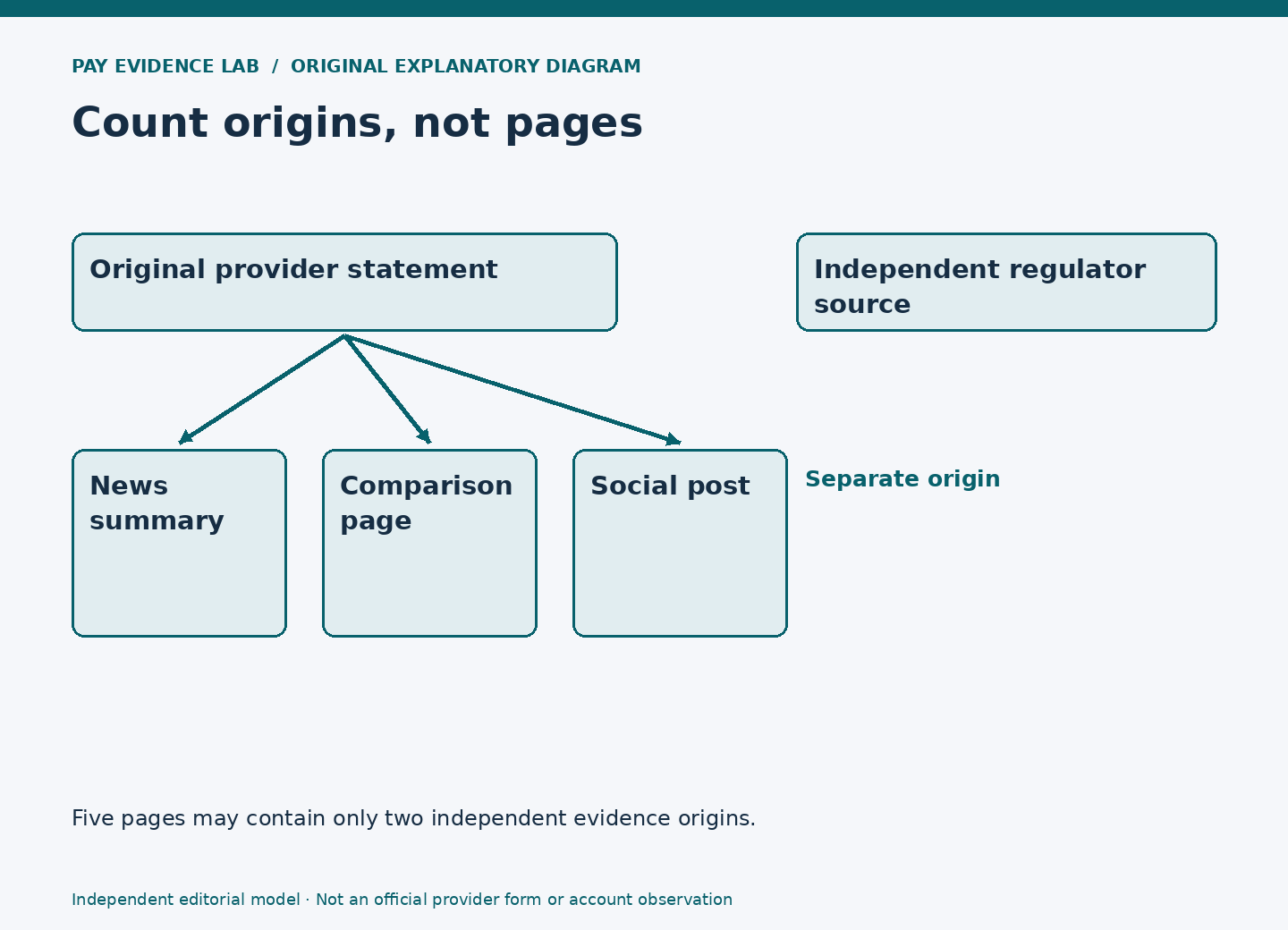
Imagine a fictional source tree: one provider statement leads to a news summary, a comparison page and a social post. A regulator’s separate general explanation appears elsewhere. The tree contains five visible pages but two distinct origins for the relevant claims. The regulator source may answer a different question, so even those origins should not be treated as interchangeable votes.
Use arrows labeled ‘quotes,’ ‘summarizes’ or ‘adds observation.’ A page that adds an interview, test or dataset should explain its method before that addition is counted as new evidence. Do not infer firsthand work merely from a confident review tone or a first-person headline.
Look for circular attribution
Sometimes two secondary pages link to each other without revealing an original basis. Mark the chain as unresolved. Repeating the claim in your own article would lengthen the circle, not close the evidence gap. The useful next step is to seek a source that directly supports the proposition or narrow the claim to what is actually observable.
A broken original link also needs care. The secondary page may preserve a historical statement, but it does not automatically establish that the statement remains current. Record the access limitation and avoid replacing the missing source with an unrelated current homepage simply because the brand matches.
State what corroboration would require
For a public-wording question, an original page may be sufficient. For a reliability claim, independent outcome evidence would be a different requirement. Define the needed evidence based on the question rather than collecting more copies of the easiest source.
A bounded finding might say: ‘The selected pages trace to one public statement; this review found repetition rather than independent testing.’ That conclusion does not dismiss the statement. It accurately describes the evidence structure and saves readers from confusing visibility with verification.
Continue the investigation
Sources and scope
- External official source: Corpay Prepaid: public product and issuer context — Name transition, PayCard/FlexCard distinction and conditions stated on the public page. Not an individual agreement or outcome study. Checked 2026-10-04.
- External official source: FTC: how to evaluate online reviews — Read several sources and consider reviewer context; appearance alone cannot establish authenticity. Checked 2026-10-04.