Two sources can appear side by side in search results while describing different periods. One may be a page viewed today, another an undated explanation, and another a dataset covering a past year. The search result’s freshness does not make their evidence contemporaneous. A time comparison begins by naming what each date means.
Use separate date fields
A review date records when you inspected the source. A publication date records when the publisher says it appeared. An effective date identifies when a stated rule or term applies, if the source supplies one. A data window defines the period represented by observations. None should be substituted for another merely because a table has room for only one date.
For a Fintwist naming study, a current public transition statement can establish the wording observed on the review date. It does not by itself establish the first day every reader saw that wording or the effective date of every program term. Keep those questions open unless a source directly answers them.
Compare like windows
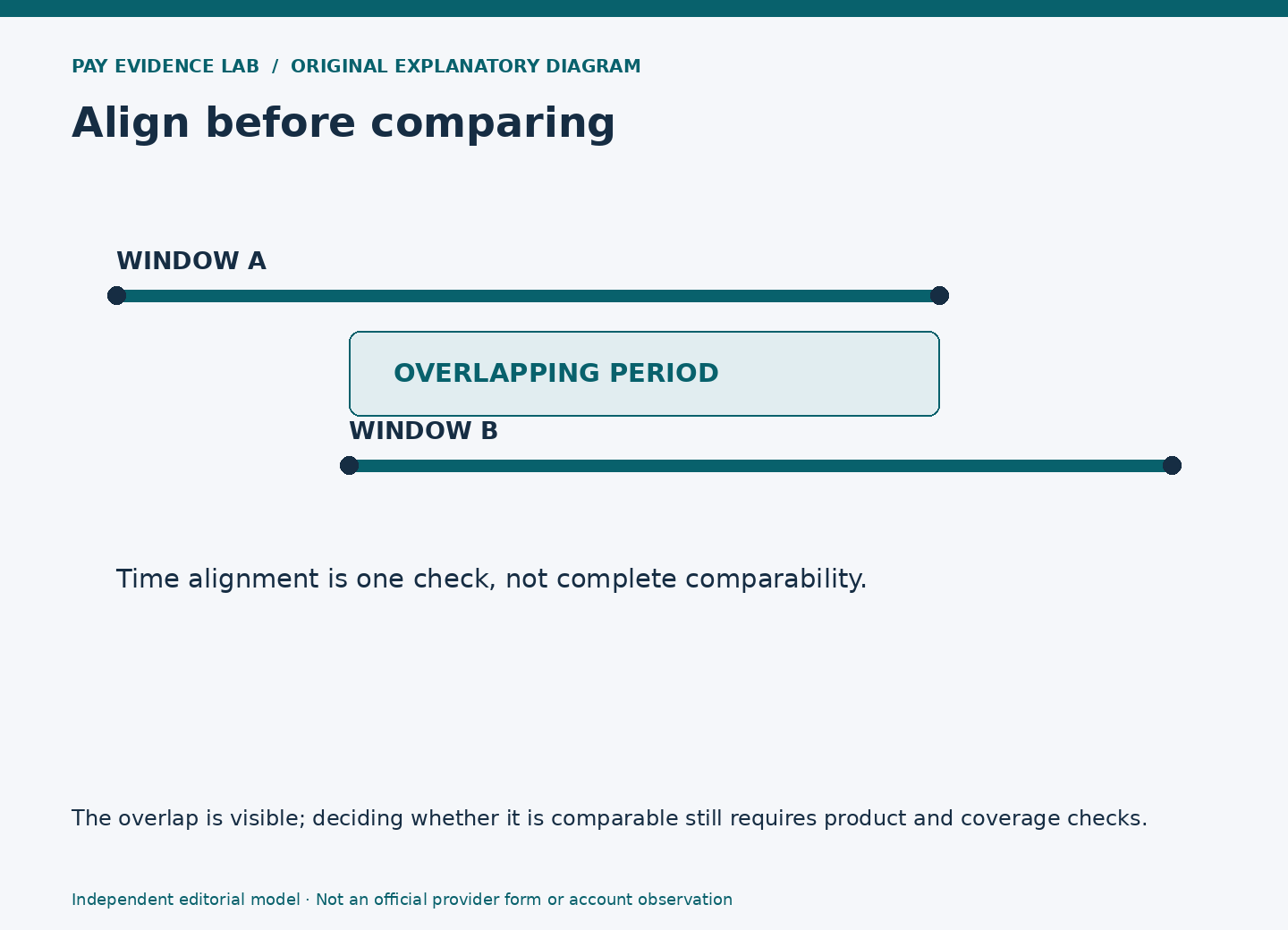
Consider two invented sets: one contains records from January through June, and another from April through September. Their totals are not a clean before-and-after comparison. The overlap contains April through June, while each set also includes a different season. A diagram of the windows often reveals the problem faster than a footnote.
If you restrict both sets to the same overlap, record the new scope and its cost. You have improved temporal alignment but reduced the period studied. That does not automatically solve product, reporting or population differences. The comparison should list the remaining gaps rather than implying that matching dates makes everything comparable.
Do not turn administrative dates into event dates
The CFPB field reference distinguishes the date received from the date sent to a company. These are administrative events. A researcher should not rename either as the date a consumer’s underlying problem began. If the actual event date is unavailable, preserve that absence instead of creating a false chronology.
A fictional record received in May could describe an earlier event. A May count therefore answers a question about records received in May under the chosen extraction, not necessarily incidents that occurred in May. This difference matters when someone tries to connect a visible count change to a product announcement.
Make the time claim inspectable
Write a short window note beside every comparison: which date field, start and end boundaries, review date and any incomplete recent period. If the source updates, retain the extraction date as well. Another reader should be able to reconstruct what you meant without reverse-engineering a chart.
A bounded conclusion might say that two selected public explanations differ as observed on a stated date. Calling that difference a historical change requires evidence of the earlier version and when it applied. Until then, describe the observed difference and the missing timeline. That is a clear result rather than an unfinished guess.
Continue the investigation
Sources and scope
- External official source: Corpay Prepaid: public product and issuer context — Name transition, PayCard/FlexCard distinction and conditions stated on the public page. Not an individual agreement or outcome study. Checked 2026-10-04.
- External official source: CFPB Open Tech: complaint field reference — Meaning of date, product, issue, company and response fields. Not a merits decision. Checked 2026-10-04.